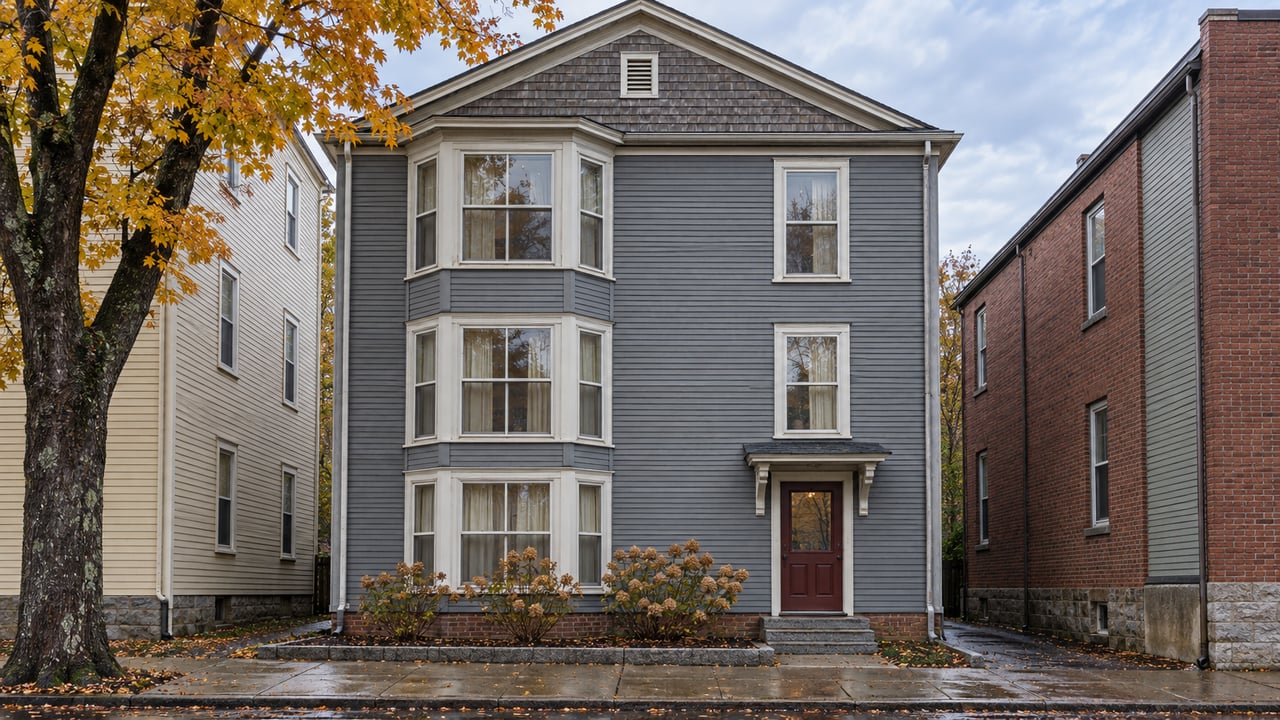
Under the rent control petition Massachusetts voters almost saw this November, two identical New Bedford three-families on the same block could have landed on opposite sides of the law. One owner lives on the first floor. The other owner lives somewhere else. The petition text exempted units in owner-occupied buildings of four or fewer units. An ordinary investor-owned three-family fit none of its other exemptions. Take an investor who buys a triple-decker from an owner-occupant and rents all three units. On the day of closing, that building would have moved out of the exemption and under the cap.
The Supreme Judicial Court blocked the measure on June 23, 2026. Its reasons say very little about whether the cap will come back.
The Clause That Ended It Was About Religion
In Cella v. Attorney General, the court ruled that Initiative Petition 25-21 broke Article 48 of the Massachusetts Constitution, which bars ballot measures that relate to religion. The problem was one of the petition's five exemptions, which covered dwelling units "in facilities operated solely for educational, religious, or non-profit purposes." The court ordered the Secretary of the Commonwealth to keep the measure off the 2026 ballot. The full opinion says the court did not reach the plaintiffs' other arguments, including the takings claim. Justice Kafker's concurrence says most of the initiative "clearly has nothing to do with religion." He added that a version drawing the line between for-profit and nonprofit owners "would have presented a very different question."
The Secretary certified nine statewide questions on July 17, and rent control is not one of them. The petition never failed with voters, though. In an Emerson College poll taken May 3–4, 2026, 60% of respondents supported a 5% cap on annual increases and 26% opposed it. In a Polity Research Consulting survey for the Retailers Association of Massachusetts, fielded April 29 to May 7, 69% said they would definitely or probably vote yes. So a measure with that much support came off the ballot because of one drafting choice, and the concurrence says how to fix it.
What The Cap Would Have Done To A Three-Family
When you price a building, the specific mechanics matter more than the ballot fight. The petition text did four things that would hit New Bedford's two- to four-family stock hard:
- It capped increases at the lower of CPI or 5% in any 12-month period.
- The cap stayed with the unit. It applied whether or not the tenant changed, so a vacancy would not reset the rent to market.
- The baseline was the rent in place on January 31, 2026. Units vacant at adoption used the last rent charged. A unit not rented for at least five years used the first rent charged after adoption.
- For buildings of four or fewer units, the exemption turned on owner occupancy. A three-family qualified only if the owner lived there. Units in buildings with a certificate of occupancy less than 10 years old were also exempt for 10 years.
Points two and three together are what matter for tenant-occupied buildings. Plenty of long-held triple-deckers carry a long-term tenant paying well under market. Under this design, that below-market rent would have become the permanent starting point for the unit, and turnover could not reset it. Most buyers underwrite a value-add multifamily on the assumption that rents catch up to market at turnover. The petition would have removed that assumption for any building the owner does not live in.
New Bedford Light's reporting showed the split well. Amir Shahsavari and Tony Lopes, president and vice president of the Small Property Owners Association, warned that rising operating costs plus a rent cap could push small landlords out. Supporters answered that the owner-occupied four-unit exemption kept many small landlords outside the law. The Light's example was Dorchester organizer Antonio Ennis, who lives in one unit of a triple-decker and rents the other two, and who said the proposal would not affect him. Both sides were describing the same building type. They disagreed because some owners live in the building and some do not.
MassLandlords has said the exemption would not have applied to buildings held in a trust or LLC. The filed petition text contains no such condition. Any future version could add that language, which is one more reason to read the actual text of whatever comes next.
Where It Stands Since June 23
The court ruling closed the ballot route for 2026. On Beacon Hill, the bills stalled before reaching a vote. Here is where each piece stands as of early October:
| Player | Position since the ruling | Date |
|---|---|---|
| Homes for All Massachusetts, Carolyn Chou | Exploring options for the 2027–2028 cycle, including another ballot question, according to Multi-Housing News | July 30, 2026 report |
| Western Massachusetts tenant organizers | Continuing to back S.1447, a city-by-city local-option bill | July 1, 2026 |
| Small Property Owners Association | Opposes rent control "in any form," including local option and temporary caps | July 1, 2026 |
| Housing for Massachusetts, Conor Yunits | Coalition staying together to counter future proposals | July 30, 2026 report |
| S.1447, Senate | Favorable committee report, referred to Ways and Means; no later action shown | July 13, 2026 |
| H.2328, House | Accompanied by a study order | August 13, 2026 |
The compromise discussed in late May and July would have given cities local opt-in authority, with a cap of inflation plus five points, maxing out at 10%. New Bedford Light reported that the framework under discussion also let rents reset to market on vacancy and set up local rent boards. It did not pass before the July 31 end of formal sessions. You can follow S.1447 on the Legislature's site.
A local-option structure brings the question back to City Hall. Councilor Shane Burgo introduced a city ballot question on rent control in 2023. Mayor Jon Mitchell vetoed that proposal and later joined mayors opposing the 2026 statewide measure. Nothing on rent stabilization or a home-rule petition appeared on the City Council agendas for August 20 or September 10, 2026.
The Rent Figure That Moved This Fall Came From HUD
While the cap debate stalled, a federal rent benchmark jumped. HUD's FY2027 Fair Market Rents for the New Bedford metro area took effect October 1, 2026.
| Unit size | FY2026, effective Oct. 1, 2025 | FY2027, effective Oct. 1, 2026 | Change |
|---|---|---|---|
| 1-bedroom | $1,230 | $1,305 | +6.1% |
| 2-bedroom | $1,527 | $1,668 | +9.2% |
| 3-bedroom | $1,831 | $1,987 | +8.5% |
Rents in large buildings barely moved over the same period. As of October 1, 2026, the average rent in New Bedford apartment properties with 50 or more units was $2,178, up 0.77% from a year earlier. One-bedrooms averaged $2,013 and two-bedrooms $2,255. That sample is large complexes, not triple-deckers. HUD's figure is a different measure: an estimate of 40th-percentile gross rent for standard-quality units. These two numbers don't line up exactly, but they point in opposite directions. The benchmark tied to voucher rents rose 6% to 9%, while large-building market rents were nearly flat.
This connects back to the petition. It did not count a tenant with a mobile housing voucher as "regulated by a public authority." A voucher unit in an investor-owned three-family would therefore have been covered. Its annual increase would have been capped at 5% or less, in a year when HUD's two-bedroom benchmark rose 9.2%. For New Bedford owners who rely on voucher tenancies, any revived proposal needs to answer how a CPI cap interacts with the federal benchmark.
A note on boundaries: Fall River is priced under a separate Providence-Fall River area, where the FY2027 two-bedroom FMR is $1,879. Comparing New Bedford and Fall River deals means comparing two different federal benchmarks.
How This Should Change An Offer On A Two- Or Three-Family
There is no current published median sale price for New Bedford two- to four-family homes, so this comes down to how you underwrite the building, not which comparable sales you pull. Here is what we do on investor acquisitions this fall:
- Price the owner-occupancy question explicitly. If the seller lives in the building and you will not, your plan would have lost the exemption under the 2026 design. Run a downside case where rent growth on non-owner-occupied units is capped near inflation and turnover does not reset rents.
- Read the January 31, 2026 rent roll. That was the petition's baseline date. A future measure could pick a new date, but long-term tenancies at below-market rent are the units most exposed to any baseline-and-cap structure.
- Separate voucher income from market income. The October 1 FMR increase is real money for voucher units. Under the 2026 text, it would have collided with a 5% ceiling.
- Track the vacancy-reset language. The local-option framework discussed in May included a market reset on vacancy. The ballot petition did not. A cap that resets on turnover affects value much less.
Owner-occupant buyers fall on the other side of the line. Under the 2026 text, someone who buys a three-family and lives in one unit would have been outside the cap entirely.
Quick Answers
Is statewide rent control on the November 3, 2026 ballot? No. The SJC blocked Initiative Petition 25-21 on June 23, 2026, and it is not among the nine certified questions.
Is it coming back? Homes for All Massachusetts has said it is exploring the 2027–2028 cycle. On Beacon Hill, S.1447 sits in Senate Ways and Means and H.2328 was sent to study. None of that is enacted law.
Would an owner-occupied New Bedford triple-decker have been exempt? Under the filed text, yes. Units in owner-occupied buildings with four or fewer units were excluded. A non-owner-occupied three-family was not exempt on unit count alone.
Does this post replace legal or tax advice? No. A future proposal's exact wording will control, so have a Massachusetts attorney review any lease or acquisition structure that depends on it.
If you are underwriting a New Bedford multifamily where owner occupancy, a long-tenured rent roll, or voucher income changes the math, Zach Midwood can run both scenarios with you before you write the offer. Book an appointment and bring the rent roll.
This article is general information, not legal, tax or financial advice. Consult a qualified professional about your situation.