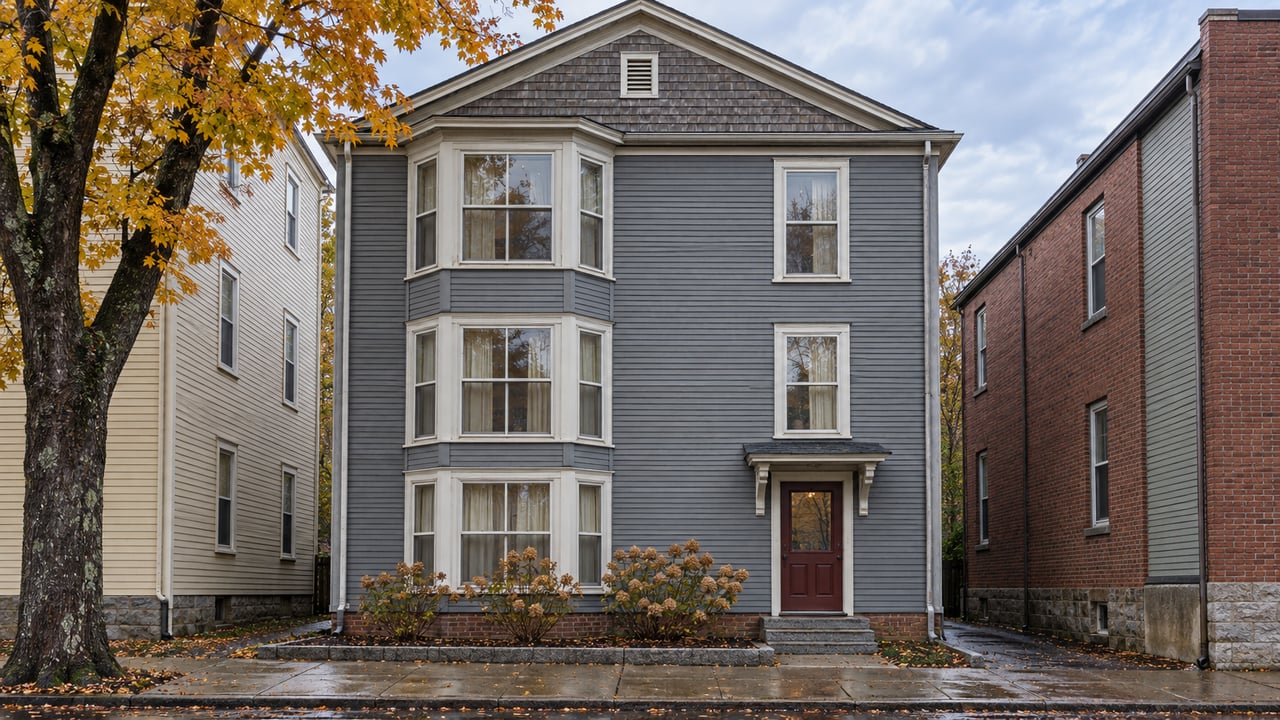
Every Providence multifamily listing shows a property tax figure, usually a single annual number sitting beside the lot size and the heating type. It looks like a fact about the building. On a two- to four-family home it is really a fact about the person selling it. Providence's tax ordinance says the owner-occupied rate "attaches to the owner(s) of the real property not to the real property itself." On the day the deed changes hands, the city starts taxing the next owner. That tax can be roughly half or nearly double the seller's number.
Providence is where this matters most in Rhode Island. In the third quarter of 2026, the city recorded 138 multifamily sales, about a third of the state's 413, according to the Rhode Island Association of Realtors Q3 2026 multifamily report. More of the state's small multifamily trades happen here than anywhere else, so this rule touches more deals here too.
Two rates on the same building
Providence puts residential buildings with two to five units in Class 1B. For fiscal year 2027, which runs through June 30, 2027, the adopted FY2027 ordinance sets these rates per $1,000 of assessed value:
| Property class | Owner-occupied | Non-owner-occupied |
|---|---|---|
| Single-family, Class 1A | $8.40 | $14.60 |
| 2–5 units, Class 1B | $7.55 | $14.00 |
| 6–10 units, Class 1C | $26.00 | $26.00 |
| 11+ units, Class 1D | $28.50 | $28.50 |
Two things in that table drive everything below. A two- to five-family home with the owner living in it has the lowest residential rate in the city, lower even than an owner-occupied single-family house. And the same building owned by someone who lives elsewhere pays $14.00, about 85% more than $7.55.
The rates are stable. The city assessor's final FY2027 levy sheet says owner-occupied and non-owner-occupied rates "remain unchanged" from FY2026. Because the rates aren't moving, the biggest swing in what a buyer will pay comes from who the owner is.
What the gap looks like in dollars
Tax is charged on assessed value, and assessed value is not the sale price. Providence's current assessments come from a statistical revaluation that set market values as of December 31, 2024. Sale prices have moved since then. The Providence multifamily median was $690,000 in Q3 2026, up 9.52% from $630,000 in Q3 2025, per the same RIAR report. So the honest way to model the difference is per $100,000 of assessed value, using the building's actual assessment from the city.
| Assessed value | Owner-occupied at $7.55 | Non-owner-occupied at $14.00 | Annual difference |
|---|---|---|---|
| $100,000 | $755 | $1,400 | $645 |
| $300,000 | $2,265 | $4,200 | $1,935 |
| $500,000 | $3,775 | $7,000 | $3,225 |
Underwriting has to start from the new owner's rate. An investor who plugs the seller's owner-occupied bill into a pro forma understates taxes by $645 for every $100,000 of assessment, every year. An owner-occupant buying from an investor is looking at a listing tax figure that overstates what they'll actually pay, provided they file.
The rate stops at closing unless the buyer applies
Section (d)(4)(iv) of the FY2027 ordinance covers the handoff. If a property sells during a year when the seller held the owner-occupied rate, the rate "is removed for that portion of the year following the sale or transfer should the new buyer not apply and be granted" the rate. The same sentence adds that "the buyer or transferee shall be liable to the city for any tax benefit wrongfully received after the date of sale or transfer."
That liability falls on the buyer. If an investor closes on an owner-occupied three-family and the lower rate somehow keeps showing on the account, the city can come back to the investor for the difference. The city collector's FAQ says rates and exemptions are reviewed when a property transfers.
Buyers who plan to live in the building get the other side of the same rule. A homeowner may apply "as of the date of purchase for the current tax year," even without owning the property on the prior December 31, and the rate is granted "pro rata for the number of days the applicant owns the property." Someone closing on an investor-owned two-family this November doesn't have to wait for next summer's bill to get the lower rate. They can apply for the remaining days of FY2027.
Four ways the rate is lost or refused
The ordinance sets conditions that a closing can break without anyone noticing. Each one can move a building from $7.55 to $14.00.
- Taking title in an LLC. "Only natural person(s) are qualified." Property partly or wholly owned by a business, nonprofit, foreclosing lender or other entity doesn't qualify. The assessor may make a good-cause exception for an entity and its members only when they swear they lived in the property on the assessment date and the entity holds title "solely for estate purposes." The ordinance doesn't name trusts specifically.
- Claiming a second homestead. An applicant can hold only one owner-occupied rate in Providence at a time. The applicant and their spouse can't be receiving a homestead exemption or owner-occupied rate on another property anywhere in Rhode Island or any other state for the same period, with an exception for legal separation or divorce.
- An unpaid housing court judgment. The assessor "shall deny" an application if there's an unsatisfied execution of record from a Providence housing court judgment for code violations against the applicant.
- Moving out. The city's exemptions page says exemptions end on conveyance, death, or moving from the property.
Getting the facts wrong costs more than the rate difference. If an applicant knowingly gives false information about ownership or occupancy, the assessor can remove the rate, recalculate the tax and charge the maximum interest allowed by law. If the information is incorrect at all, knowingly or not, the assessor can impose back taxes up to the full amount owed.
The filing itself, and the dates on the calendar
The application is the "Owner Occupied Certification" on the Providence assessor's online portal. It asks for a Rhode Island license or state ID (a City ID is accepted) plus one more document. That can be a bank statement, mortgage statement or paystub from the last 30 days, or a state or federal document such as a Social Security, Medicare or Medicaid statement. Applicants declare that the Providence address is their "predominant and principal home."
For a buyer reading this in early November 2026, here are the dates that matter:
- December 31, 2026, at midnight: the assessment date that sets owner-occupied status for the next tax year. The city's exemptions page says the applicant must own the property before December 31 and use it as a primary residence.
- January 24, 2027: the third FY2027 quarterly installment. The fourth falls on April 24, 2027.
- March 15, 2027: the filing deadline tied to that December 31 status. The assessor may accept late applications for good cause, for the current or previous year's taxes only.
- Late June 2027: Providence mails tax bills once a year in late June.
The city doesn't publish a guaranteed processing time, or a cutoff date for when a mid-year approval first shows up on a bill. A buyer closing in December should file right away instead of working backward from March.
Assessments themselves are also scheduled to change. The city has issued an RFP titled "December 31, 2027, Full Revaluation," and the state schedule lists 2027 for Providence's next full revaluation. Anyone holding a building past that date is modeling a rate applied to a number that will be reset.
Where the owner-occupant line shows up again
The city rate isn't the only place Rhode Island separates owner-occupied buildings from investor-owned ones. The state's Non-Owner Occupied Property Tax, effective July 1, 2026, applies to residential property assessed above $1 million when the owner doesn't live there at least 183 days. It charges $2.50 per $500 of value above the threshold. It exempts qualifying long-term rentals rented at least 183 days, and a multifamily building isn't subject to it if one unit is owner-occupied or qualifies for an exemption. Most Providence two- to four-families fall below that line or are rented long term, but the same distinction applies.
The same split appeared in Providence's rent-stabilization ordinance this spring. According to the City Council's FAQ, the proposal exempted small owner-occupied buildings of one to four units. It passed April 16, 2026, the mayor vetoed it April 17, and the Council couldn't override the veto, so it never took effect. In both the state tax and the vetoed rent ordinance, a three-decker with its owner living on the second floor falls under different rules than the same building owned by someone who lives elsewhere.
Market timing makes the tax line more important. Average days on market for Providence multifamily rose from 28 in Q3 2025 to 36 in Q3 2026, and sales fell 10.39%. When buildings sit longer, buyers have more time to rebuild the expense side of the numbers, and a tax figure based on the wrong owner type is one of the easiest errors to catch.
Quick answers
Does the seller's owner-occupied rate transfer to me? No. Under the ordinance the rate attaches to the owner, and it's removed after the sale unless the buyer applies and is approved.
I'm buying a two-family in my own name and moving in. Do I wait a year? The ordinance lets a buyer apply as of the purchase date for the current tax year, prorated by the days they own the property.
Can I hold the building in an LLC and still live there at the lower rate? Only natural persons qualify. The narrow exception covers entities holding title solely for estate purposes, granted at the assessor's discretion on a sworn declaration.
Does this apply to a six-unit building? No. Buildings with six to ten units pay a single $26.00 rate, so the owner-occupied split stops at five units.
All of this is general information drawn from the city's published ordinance and assessor materials. It isn't legal, tax or financial advice, so confirm your own eligibility and title structure with the assessor's office, an attorney or a tax professional.
When I underwrite a Providence two- to four-family, I start with how the buyer will hold title and who will live in the building, then rebuild the tax line around that, and only then look at rents. If you're pricing an offer or getting a tenant-occupied building ready to sell and want the tax side modeled correctly before you commit, Zach Midwood can walk through the numbers with you. Book an Appointment.