If you are comparing Providence and Bristol County for your next small multifamily purchase, the answer is not as simple as crossing a state line. On paper, one market can look cheaper or easier, but the real story comes from housing stock, rent support, and how much submarket variation you are willing to underwrite. This guide breaks down where Providence stands out, where Bristol County can compete, and how to think through the decision like a practical investor. Let’s dive in.
Providence vs Bristol County at a Glance
Providence is the denser and more renter-oriented market in this comparison. According to U.S. Census QuickFacts for Providence, the city has 81,131 housing units, a 41.4% owner-occupied rate, and population density of 10,373.5 people per square mile.
Bristol County, Massachusetts is much broader and more owner-occupied. The same Census source shows 246,345 housing units, a 62.3% owner-occupied rate, and population density of 1,047.2 people per square mile. For investors, that difference matters because Providence behaves more like a classic urban rental market, while Bristol County behaves more like a collection of distinct cities and towns.
Housing Stock Favors Providence
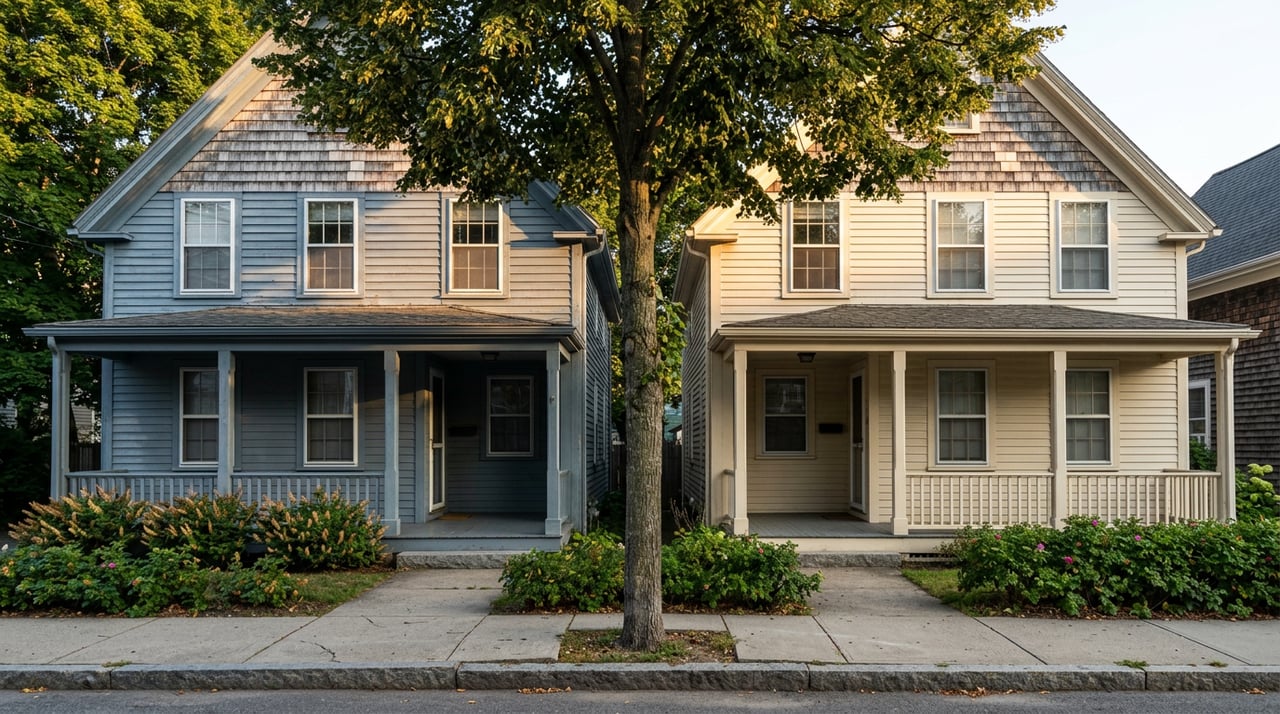
If your main strategy is 2-4 unit investing, Providence looks more naturally built for it. A Providence housing profile shows 16,454 units in 2-unit structures and 22,457 units in 3- or 4-unit structures, which totals about 49% of all housing units.
That same profile shows 45,653 units built in 1939 or earlier, or about 58% of the housing stock. In practical terms, Providence offers a lot of the older 2-4 family inventory that small multifamily buyers often target, along with the repair, layout, and systems issues that usually come with older buildings.
Bristol County still has meaningful small multifamily inventory, but the mix is different. A Bristol County housing profile shows 23,468 units in 2-unit structures and 37,884 in 3- or 4-unit structures, or about 25% of total housing units combined.
The same Bristol County profile shows 127,565 detached single-family units and 9,043 attached single-family units, with 77,684 homes built in 1939 or earlier, or about 32% of the total stock. That points to a market where multifamily opportunities exist, but they sit inside a much larger owner-occupied and detached-home landscape.
Bristol County Needs a City-by-City Lens
One of the biggest mistakes small investors make is treating Bristol County like one market. It is not. The county includes very different city-level conditions, and even the research notes that countywide averages can hide major submarket differences.
That means your underwriting in Fall River may not look like your underwriting in New Bedford, Taunton, or Attleboro. If you are shopping Bristol County, it makes more sense to compare city comps, rent ceilings, and rehab scope than to rely on one countywide number.
Listing Prices Are Closer Than You Might Expect
If you assume Bristol County is dramatically cheaper than Providence, the current listing data does not fully support that. Redfin’s Providence multifamily page shows 120 active listings with a median listing price of $675,000.
The same Providence research includes current examples ranging from about $399,900 to over $1.1 million, plus a luxury outlier at $3.5 million. That tells you there is a wide spread, but the median still puts Providence firmly in a competitive small multifamily bracket.
In Bristol County, Redfin’s county multifamily page shows 148 active listings with a median listing price of $630,000. Sample listings in the research range from roughly $455,000 to just over $1.0 million.
The gap between $675,000 in Providence and $630,000 in Bristol County is not huge. For a small investor, that means the better deal often comes down to the specific asset, condition, and income profile, not just the map.
Providence Has Stronger Rent Support
Rent matters because it drives how much room you have to absorb debt service, vacancies, repairs, and turnover. Based on Census QuickFacts, median gross rent is $1,408 in Providence compared with $1,245 in Bristol County.
The research also points to current market pages showing median rent around $2.3K in Providence and $2.0K in Bristol County. While those figures come from a different methodology, they point in the same direction: Providence generally supports somewhat higher rents.
For investors, that usually means Providence gives you a stronger rent numerator in your underwriting. That does not guarantee a better deal, but it can help offset a higher acquisition basis or heavier renovation budget.
Bristol County Is Not Automatically Better Yield
A lower-rent market can still work if your basis is low enough. But one useful reality check here is owner-occupied value. The Census data puts Providence’s median owner-occupied home value at $362,200, while Bristol County sits at $451,200.
That matters because it suggests Bristol County’s broader housing market is not simply a cheap alternative. When you combine lower gross rents with a higher countywide median owner value, the yield picture can get tighter than many first-pass investors expect.
In other words, you should not assume Bristol County offers better cash flow just because some asking prices look a bit lower. You still need disciplined deal-by-deal underwriting.
Fair Market Rent Adds Useful Context
If you want another benchmark for rents, HUD’s FY2026 Fair Market Rent schedule lists the Providence-Fall River, RI-MA HMFA at $1,729 for a 2-bedroom, $2,087 for a 3-bedroom, and $2,480 for a 4-bedroom.
The research notes that this HMFA includes several Bristol County towns such as Attleboro, Fall River, North Attleborough, Rehoboth, Seekonk, Somerset, Swansea, and Westport. That makes HUD’s schedule a helpful reference point when you are sizing rents across parts of the South Coast and nearby Rhode Island markets.
It is not a substitute for actual unit-level comps, but it can be a useful check when your underwriting starts to get too optimistic. That is especially true if you are evaluating value-add potential on older 2-4 family properties.
How Small Investors Can Choose
For most small multifamily investors, the choice comes down to strategy.
If you want a market that is more renter-heavy and more structurally aligned with 2-4 family ownership, Providence is often the cleaner starting point. The stock mix, density, and rent environment all support that thesis.
If you want a wider field of options and are comfortable comparing one city against another, Bristol County can still make sense. But you need to underwrite it with more precision, because countywide averages can blur real differences between submarkets.
Here is a simple way to think about it:
| Investor Goal | Better Fit |
|---|---|
| More renter-heavy environment | Providence |
| Larger concentration of 2-4 family stock | Providence |
| Broader set of city and town options | Bristol County |
| Countywide numbers that require local filtering | Bristol County |
| Slightly lower current multifamily median listing price | Bristol County |
| Somewhat stronger rent support | Providence |
What to Watch Before You Buy
No matter which side of the line you prefer, focus on the same core checks before you make an offer:
- Compare actual 2-4 family comps, not broad housing averages.
- Confirm current rent levels against unit size, condition, and location.
- Budget realistically for older-building repairs, especially in pre-1940 stock.
- Review turnover and renovation costs with conservative assumptions.
- Treat county averages as background, not as final underwriting.
This is where hands-on multifamily experience matters. Older properties can look similar online but perform very differently once you account for deferred maintenance, layout issues, and the real cost of getting units rent-ready.
Bottom Line for Providence vs Bristol County
Providence is the more multifamily-native market in this comparison. It is denser, more renter-oriented, and far more concentrated in the 2-4 unit housing stock that small investors typically chase.
Bristol County is the more varied alternative. It can offer solid opportunities, but the better approach is to compare specific cities and properties rather than rely on countywide averages or assume the state line creates a major pricing discount.
If you are weighing Providence against Fall River, New Bedford, Attleboro, or another Bristol County submarket, the smartest next step is property-level underwriting. If you want help pressure-testing the numbers, rehab scope, or local comps across the South Coast and nearby Rhode Island markets, connect with Zach Midwood.
FAQs
Is Providence better than Bristol County for first-time multifamily investors?
- Providence can be easier to understand as a small multifamily market because its housing stock is more heavily concentrated in 2-4 unit properties and it has a more renter-heavy profile.
Are multifamily properties much cheaper in Bristol County than in Providence?
- Not necessarily. Current listing data in the research shows a median of $675,000 in Providence versus $630,000 in Bristol County, which is only a modest difference.
Does Providence support higher rents than Bristol County?
- Yes. The research shows Providence with higher median gross rent and higher current market rent figures than Bristol County.
Should you underwrite Bristol County as one market?
- No. Bristol County includes multiple cities and towns with different pricing and rent patterns, so a city-by-city approach is more reliable.
Why does older housing stock matter in Providence multifamily investing?
- Older 2-4 family inventory can create more opportunity, but it also usually means you need to budget carefully for repairs, updates, and turnover work.